
the article written by Joumana Nasr in “Al-Massira” – Issue 1696
the article written by Joumana Nasr in “Al-Massira” – Issue 1696.
—
Ali Abou Dehn: The Fires of Hell are More Merciful They tried us for our dreams and fed us rats and cockroaches (1)
From the hell of detention to freedom emerged the head of the “Association of Lebanese Detainees in Syrian Prisons,” Ali Abou Dehn, who once considered death equivalent to freedom due to the injustice and torture he and other Lebanese detainees endured in Syrian prisons.
The day he received the news of his release to freedom on December 15, 2000, he was walking in the corridor of Sednaya Prison. Suddenly, he heard his name. It was the first time he had heard someone call him by his name since his arrest 13 years earlier on December 28, 1987. The guard said to him literally: “Ali Abou Dehn, terminate your relationship with the prison.” At first, he didn’t comprehend the jailer’s words and asked him, surprised, “Why?” The jailer answered, “Release from Sednaya Prison.” He also didn’t believe what he heard. He was more doubting than Thomas. Then the jailer pulled a paper from his military jacket pocket and showed it to Ali, who read his name for the first time in 13 years on a list of detainees to be released. Ali says: “As soon as I read my name, I froze on the spot. I couldn’t walk anymore. They carried me inside one of the cells, and there my fellow detainees, who were of Syrian nationality, gave me clean clothes and 600 Syrian lira and told me, ‘Don’t hope too much, maybe they want to return you to Tadmur Prison.’ But I wasn’t feeling anything. I was detached from the real world. And when the hour of freedom struck, they rushed to me, kissing me and praying for me, and they asked me to work on the issue of getting them out of Syrian prisons. At that moment, I cried. Yes, I cried a lot because we had lived together for 8 years, and I felt that the moment of parting hurts…”
They gathered us in a large hall in Sednaya prison, and there I met a Lebanese detainee I thought had been released to freedom long ago. Each of us began telling our story. I won’t hide from you that some were reserved because they were afraid it might just be a trick to take us to execution!!!! We spent one last night in Sednaya prison, and the next day they took us for military interrogation and bid us farewell with a few slaps, not to mention the psychological torture and insults.”
The frame of freedom was not easy for any detainee who lived through the most severe types of psychological and physical torture at the hands of executioners. Abou Dehn narrates, “I felt strange. The first 15 days I spent crying. I was letting out all the sadness inside me… Believe me, the change I lived between night and day was one of the most severe types of psychological torment, and this is the case for all detainees released from Syrian prisons.”
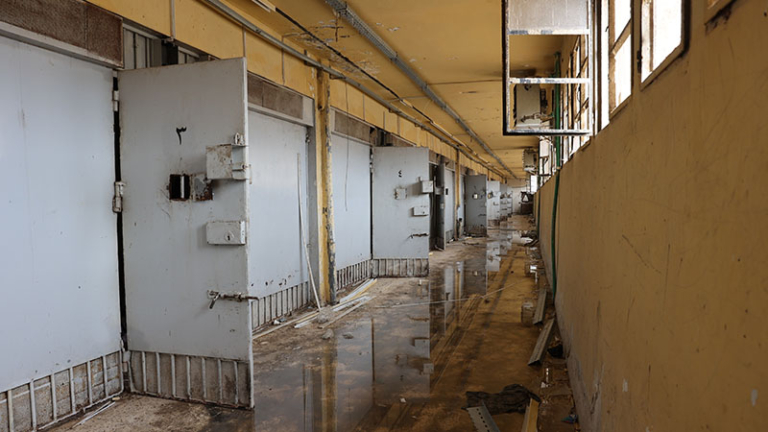
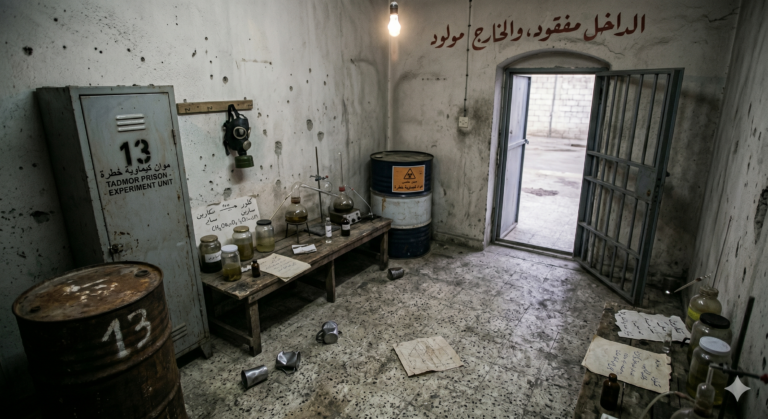
Ali Abou Dehn was one of the Lebanese prisoners who were taken to prisons by Syrian intelligence agencies. He spent thirteen years in the darkness of Syrian cells, most of it in “Tadmur” prison, which he likens to “hell,” and he is correct in this analogy; the fires of hell might be gentler than the brutality of this infamous prison, known for its cruelty and the inhumanity of its jailers. Whoever emerges from this prison alive is like one born again, but without being able to rid themselves of the marks of torture imprinted on their body and soul.
Before his capture, Ali Abou Dehn dreamed of obtaining a visa to immigrate to Australia, like hundreds of Lebanese who could no longer live in their homeland, especially during the period of Syrian guardianship. But instead of getting a visa for immigration from the Australian embassy in Damascus, Syrian intelligence granted him a visa to Tadmur prison, fabricating the common, ready-made charge of dealing with the Israeli enemy. Before reaching Tadmur, he went through what resembled a via dolorosa… from the Suwayda branch where he was “arrested,” to the Slaughterhouse branch, then the Area branch, then the Palestine branch, then the Military Intelligence Investigation branch, and finally to Tadmur prison. Before being released after thirteen years, he was taken to Sednaya prison, where prisoners are prepared for release. The beginning was with changing his clothes. He who had not changed the clothes he was wearing since his entry on December 28, 1987, until 1990, after they had worn out and torn. Is there anything harsher than the feeling of time, where a prisoner spends more than three years watching his clothes deteriorate bit by bit.
The Culture of Torture The grim atmospheres described by Ali Abou Dehn and the black “tales” he recounts and the tragedies he endured inside the prison are now known: the extremely cruel German chair, the cupboard that makes the prisoner resemble an animal, torture with electricity, whipping, suspension, sleep deprivation at night, intimidation with rape… As for the whips (Kirabej), they have names or nicknames like Sabah, Samira Tawfiq, Fahd Ballan… as well as the Abtah whip and the Al-A’raj whip… named after the sounds made by the larynx under the skin… not to mention the obscene and vile insults, and the despicable descriptions: you pig, you dog, you donkey… Mothers, wives, and sisters were not spared from the foul insults, as is the habit of the jailers of the Syrian regime.
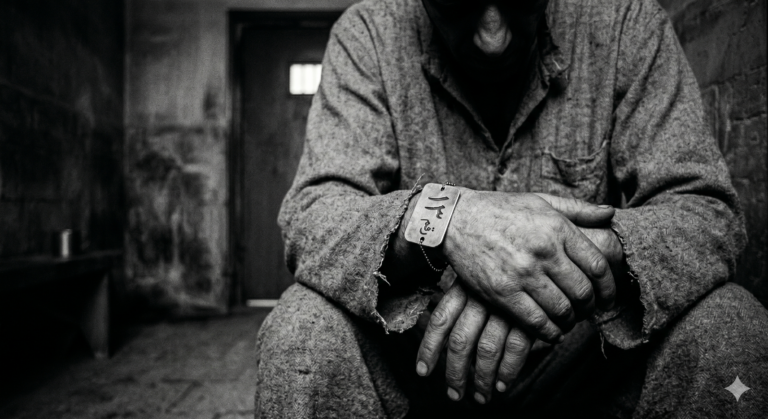
Even names were abolished, as also customary. Ali’s name became Number 6 first, then 13, then 15… The numbers change but the person remains himself, a crushed number, without existence or face, a person who is not human in the eyes of the Baathist jailers. Perhaps this is the ultimate stripping of a human being’s humanity.
As for punishment for dreams or trying prisoners on charges of dreaming, it is harsher than punishment for actions prisoners commit that displease the jailers… Yes, they even managed to confiscate dreams from the imagination of the detainees, just as they confiscated their years and their lives…
Stench and Scabies Ali Abou Dehn narrates tales and stories from the heart of the prison that surpass imagination, painful and sarcastic tales, black and absurd. For example: shaving, pulling molars, sleeping head-to-toe in a space of 20 centimeters per prisoner, the “burtail” (hunger/starvation), theft practiced by the jailers… Among his amusing and painful tales is the story of the plate of rice and chicken that the prison commander honored the prisoners with as a gift on the Baath “party” anniversary. But the jailer who brought it urinated in it before giving it to the prisoners. Ali was peeking through a hole in the prison when he saw him commit this heinous act, but he didn’t want to tell his comrades, so as not to spoil their enjoyment of the little chicken and rice.
In Tadmur prison, where those who enter are lost and those who leave are reborn, it is not surprising for a friendship to form between a prisoner and a rat. This is what happened with Ali, who saw a rat in his solitary cell and started feeding it until it became his friend. He would share his already scarce and poor daily food with it, and play with it, until it became “my new companion and my solace in my solitude.” One morning, the jailer saw the hole in the corner of the wall and proceeded to seal it with concrete. The mouse disappeared, and a friendship that lasted four months died…
The state of “animalization” was not only lived by the prisoners in their bodies and souls through the treatment of the jailers, but sometimes punishment forced some of them to swallow a dead rat, a sparrow, or cockroaches… Prisoners spent days amusing themselves by watching ants, envying them for their freedom of movement. While books and magazines were completely absent from Tadmur prison, the prisoners invented a way to pass the time and find fleeting amusement: they would take turns narrating films and series they had seen. The narrator would play the role of the storyteller, dividing the stories to add an element of suspense. As for Ali Abou Dehn, he alone would recall stories he had read before and conjure up vocabulary, flipping through the pages of the “dictionary” in his head to preserve his memory from forgetting.
Ali Abou Dehn, who left Tadmur prison semi-crippled after receiving all kinds of torture, beating, whipping, and kicking like all his comrades, wanted to write a testimony about the tragedy of captivity—an honest, realistic, true, and painfully truthful testimony. He published it in his two books, “Returned from Hell” and “Those Who Left the Syrian Graves,” which joined the “series” of Syrian prison literature. They were a good witness to the brutality of these prisons and the Syrian regime’s violation of not only a person’s right to life and liberty, but their very humanity. He laments a state that does not ask about its detainees and bets on the death of the detainees’ families to kill the issue.
“625 Lebanese detainees are still in Syrian prisons, and their names are documented with the Lebanese authorities, which provided the names via a Lebanese-Syrian committee established in 2000. The names were sent to Syria in 2004. The committee was composed of Judge Joseph Maamari and Judge George Rizk. They would take the names of the detainees from us, from the late Ghazi Ade, from Lokman Slim, and from others.” Abou Dehn continues, “We established the association and collected all the names, reaching 628 detainees in Syrian prisons, and we handed them to President Saad Hariri. We met with him and gave him all the data. He told us, ‘I will work on them, I will be faithful to them,’ and he took them with him to Syria. He met with the presidency of the government there, but they denied the existence of any detainees.”
He continues: “As president of the Association of Detainees in Syrian Prisons, I say that there are still prisoners and detainees in these prisons, like Sednaya prison and Adra prison and others, without any proof. And we cannot confirm that any detainee is still alive unless documents confirm it to us. The proof of this is the arrival of the corpses of martyred detainees one after another, the last of whom was the martyr Qays Munzer from Dahr El-Ahmar, who was in the Public Security and was arrested in 2006, and was returned dead to his family in 2016. And Yaacoub Shamoun was released in 2012 and reported the presence of other detainees.”
On September 11, 2012, former MP Eli Kheiroz submitted a question to the government via the presidency of the National Council about expanding the scope of work of the governmental crisis cell formed by the Council of Ministers on August 16, 2012, to solve the issue of kidnapped Lebanese in Syria, to include finding an urgent and final solution to this issue. In 2009, MP Ibrahim Kanaan submitted an accelerated, repeated proposal to the parliament, which remained frozen until 2013. In 2013, the file moved and was referred to the Administration and Justice Committee, which transferred it to the Finance and Budget Committee, and to this day the projects remain in drawers amidst the continued insistence of the Syrian regime on denying the existence of any Lebanese detainee in Syrian prisons.
Where are they? Alive or remains? They are definitely in Syrian prisons.